

ERP for manufacturing From inputs to the ledger
UGLA for food and industrial manufacturers: recipes, planning, the shop floor, stock, purchasing and accounting in one system.
Book a demoOr we'll call you back →
The life of one client order
From the client's order to the batch's cost: eight stages. Each press of “Next step” takes one step at both plants at once.
Client order No. 318Smak LLC
- 1,200 ×Tomato sauce, 0.5 kg66,000 ₴
- 400 ×Tomato paste, 0.5 kg27,600 ₴
Total93,600 ₴
Without UGLA0 of 1414 steps
With UGLA0 of 88 steps
−6steps per order
5→1manual entries
Without UGLA, the same order is typed in by hand 5 times; with UGLA once, when the manager enters the order.
Both plants have just received a client's order.
Order2 → 1
- Manager takes the order by e-mail
- Manager copies it into the production spreadsheet
- Manager enters the client's order
- It shows how much is already in stock and how much to make
Plan2 → 1
- Planner asks the warehouse how much finished stock there is
- Planner works out raw materials by recipe in Excel
- Planner runs planning: UGLA drafts the production orders and the supplier orders
Raw materials2 → 2
- Buyer orders the raw materials that are short
- Storekeeper enters the waybill, and a raw material under a new name becomes a duplicate
- Buyer sends the prepared order to the supplier
- Storekeeper accepts the waybill against the order: names from reference lists, no duplicates
Shop floor2 → 1
- Foreman gets the job on paper
- Foreman logs the output and raw materials used in a journal
- The job appears on the shop floor's screen, by recipe
- Foreman marks the output on the shop floor's screen
- Raw materials are written off by recipe
Batch2 → 1
- Storekeeper posts the batch to stock from the journal
- Storekeeper types the labels into a separate program
- The batch is posted to stock
- Storekeeper prints the labels from a template
Shipment1 → 1
- Manager writes the delivery note and takes the documents to be signed
- Manager ships against the order; the documents are signed in Diia
Accounting1 → 0
- Accountant moves output, write-offs and shipment into BAS
- Output, write-offs and shipment go to the ledger as postings
Cost2 → 1
- Accountant works out the batch's cost at the end of the month
- Owner sees the cost “roughly”
- The batch's cost is calculated from actual write-offs
- Owner sees the batch's cost and the order's margin
a person's step UGLA does it
Without UGLA: sales, production, stock and accounting in separate programs and Excel. We count people's steps; what UGLA does by itself is not counted as a step.
What hurts in manufacturing
“We plan production in Excel; the cost is a guess.”
The real cost of every batch
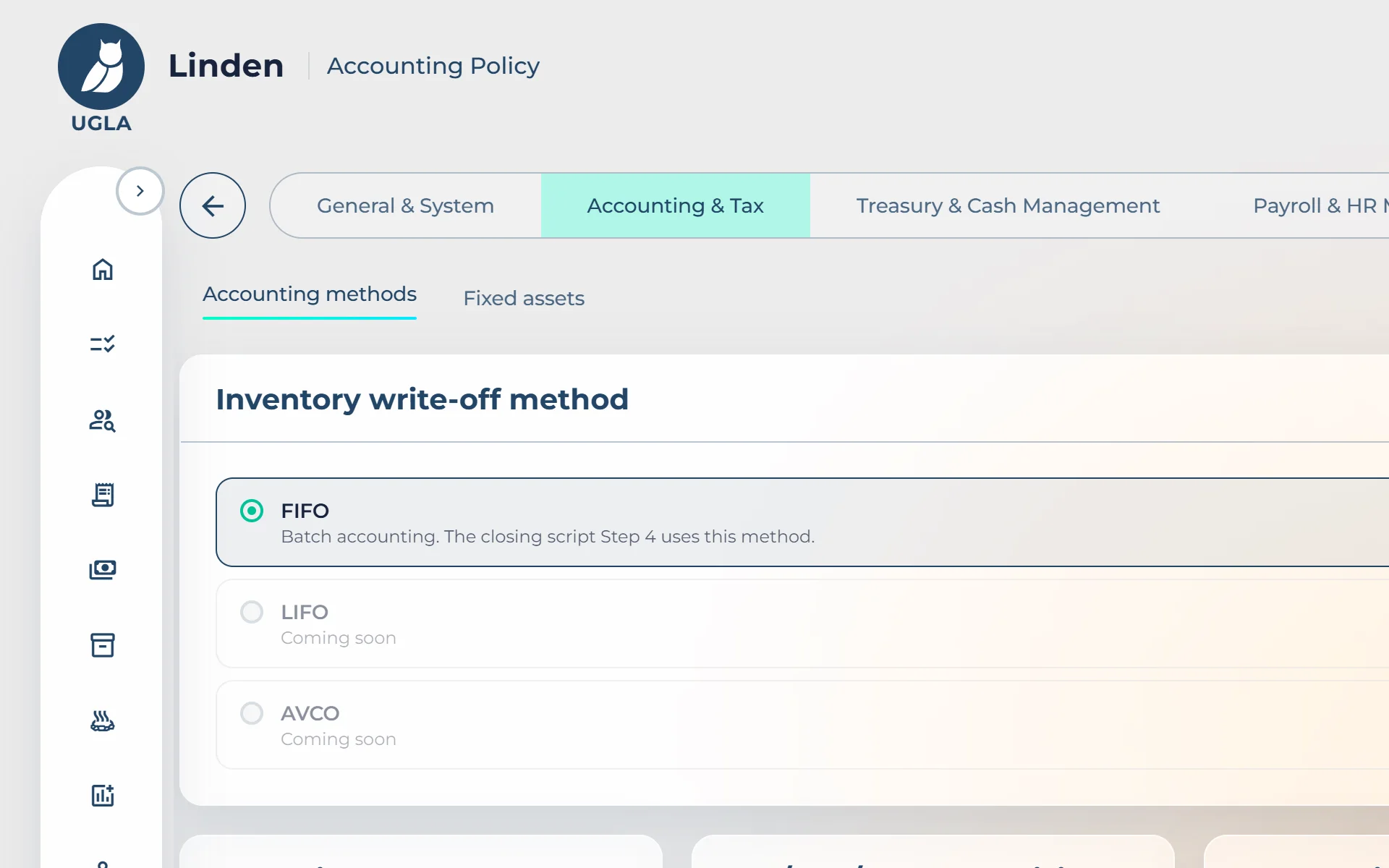
Recipes, components and finished goods with real purchase prices. The production order writes off materials by itself, and the accounting policy sets the write-off method.
One raw material is entered under several names and bought several times.
6–17% less on purchasing
A manufacturer turning over billions of hryvnias removed 17% of its nomenclature as duplicates just by bringing its data into UGLA. A manufacturer buying ₴2.5 million a month saves ₴150,000–425,000 against a ₴13,185 subscription.
17%of the nomenclature were duplicates before the first purchase
One raw material is entered under several names and bought several times.
6–17% less on purchasing
A large manufacturer removed 17% of its nomenclature as duplicates just by bringing its data into UGLA: raw materials are no longer bought under several names.
17%of the nomenclature were duplicates before the first purchase
Planning production and purchasing takes the team at least two working days.
Two days of planning in 5–10 minutes
Production planning in one run: smart supply-chain optimization turns client orders, the sales plan and stock into supplier orders, production orders and transfers.
5–10 mininstead of at least two of the team's working days
A new system looks more expensive than the one already in place.
Pays for itself from 0.53% of purchasing
The low end of the saving covers the whole subscription at 0.53% of purchasing, and at 0.20–0.34% for large plants. Moving off BAS pays back in under five weeks.
0.53%of purchasing, and UGLA has paid for itself
Implementing an ERP costs as much as another production line.
32–47% cheaper than BAS over three years
Implementation and support counted. UGLA's implementation costs $300 once, and nothing until the end of 2026; 200 hours with a BAS partner cost ₴300,000–340,000.
−32–47%against BAS over three years, implementation and support included
Same flour, one item
The storekeeper writes “Wheat flour premium”, the supplier's invoice says “Flour prem. 50kg”, the technologist's recipe “flour wheat premium grade”. In an ordinary nomenclature that is five raw materials: the plan sees only part of the stock, and the flour gets bought again. UGLA builds the name from reference lists, so the raw material exists once.
- items for one raw material
- 5
- separate purchases
- 5
- seen under “Wheat flour premium” of 3,400 kg in stock
- 1,250 kg

How much do you buy?
150,000₴ a month, 6% of purchasing
The low end: manufacturing saves at least 6% of purchasing once duplicate raw materials and supplies are gone.
What UGLA does in manufacturing
- RecipesComponents, finished goods, recipesthe real cost of every batch
- PlanningProduction plans and ordersavailable quantity from stock
- Shop floorShop-floor interface and write-offslabels from your templates
- EquipmentMaintenance and historymaintenance calendar
- ContractsB2B, B2C and B2G contracts and actswholesale and public procurement
Certified and connected
- ISO/IEC 27001information security
- ISO 9001quality management
- Diia and QESdocument signing
- Nova Poshtadelivery
Certified and connected
- ISO/IEC 27001information security
- ISO 9001quality management
Priced per seat
You pay only for seats, by role. Training, support, updates and every module are included.
Prices for Ukraine, incl. VAT.
- Full accessowner, accountant, manager $30 per seat a month · $25 from 11 seats
- Stock and salesstorekeepers, cashiers $10 per seat a month
- Shop floor and supportshop-floor workers, cleaning $3 per seat a month
Example: a 25-person manufacturer, 6 full seats, 8 in stock and sales, 11 on the shop floor: $293 a month.
Work it out with a managerUGLA · bill a month
- 6 × Full access at $30$180
- 8 × Stock and sales at $10$80
- 11 × Shop floor and support at $3$33
Implementation and data migration, one-timeOffer until 31.12.2026$300 $0
First month$593$293
Then $293 a month
Pay as you use
Only what depends on volume is billed separately. Everything else is in the seat price.
- Built-in call centre$0.0056 a minutebilled by the second, plus the carrier's tariff
- E-mail campaigns$0.22 per 1,000 e-mailscampaigns to customers from the CRM
- Storage above 20 GB$0.067 per GB a month20 GB per user is in the price
- Built-in call centre€0.005 a minutebilled by the second, plus the carrier's tariff
- E-mail campaigns€0.20 per 1,000 e-mailscampaigns to customers from the CRM
- Storage above 20 GB€0.06 per GB a month20 GB per user is in the price
Common questions
We are already on BAS/1C. Why move?
Over three years UGLA is 32–47% cheaper, implementation and support included, and the move pays back in under five weeks of the low-end saving. Data migration is free until 31 December 2026.
What about Odoo or Business Central?
Over three years with implementation UGLA is 49–54% cheaper than Odoo, and its subscription is 55–57% below Business Central's when every employee has a seat. Accounting with Ukrainian reporting and PRRO are already included, and implementation costs $300 once, nothing until the end of 2026.
UGLA and Odoo compared →UGLA and Business Central compared →
How long does the launch take?
2–4 weeks from contract to work: set-up and training run in parallel. Before buying, you can run a 14-day pilot on your own data.
What hardware do we need?
Ordinary phones, tablets and computers with a modern browser, plus common receipt and label printers. We will tell you what suits you; hardware is bought separately.
Is our data protected?
Yes. UGLA is certified to the international standards for information security, ISO/IEC 27001, and quality, ISO 9001, and backups are included in the price.
Where does the data the AI assistant works with go?
Nowhere outside UGLA. We host the AI models in our own cloud infrastructure, so your data does not go to third-party AI services. The assistant sees only what the person asking can see.
Can we move to UGLA without stopping work?
Yes. The UGLA team moves your reference lists, stock and history, and for a month you work in both in parallel. Implementation and data migration are free until 31 December 2026.
Do the EU prices include IVA?
No. Prices for the European Union are shown without IVA; the tax is charged under your country's rules.
We'll show it on your data
Pick a time that suits you: 45 minutes online with a manager, a demo for your industry and a price for your team.